Featured Post

Me and My Mission

Showing posts with label Corporate Control. Show all posts

Wednesday, April 19, 2017

The Global Civil War: The Enlightenment, Nationalism, Anger, Inequality, IS, and Trump


 Age of Anger by Pankaj Mishra
Age of Anger: A History of the Prestent by by Pankaj Mishra, published by Farrar, Straus and Giroux, 2017.

Why is the world so angry?

These three programs from CBC Ideas help weave together the threads that reveal the answer.

Tuesday April 18, 2017

Globalized Anger: The Enlightenment's Unwanted Child

Trumpism. Hindu nationalism. ISIS. Chinese expansionism. People everywhere seem fed up with the status quo, and their anger and intolerance are finding political expression. But why? Pankaj Mishra believes that the current unrest isn't about any so-called "clash of civilizations" between the enlightened and unenlightened. He thinks the globalized anger is the legitimate offspring of the Enlightenment itself. He speaks with Paul Kennedy about his provocative book, The Age of Anger: A History of the Present.
"We should really look at the modern world as constituted by sameness and similarity rather than religious, cultural, theological difference. Obviously, people make all kinds of claims for their cultural and theological differences, whether it's members of Islamic State, or whether it's Christian fundamentalists or white nationalists, who are very insistent that their, race their religion, their nation, is unique and they are speaking on behalf of that -- on behalf of a particular tradition.

But I think the task of the interpreter is to go beyond these statements, not take them at face value. And to see what are the ways in which these supposedly disparate and diverse peoples are connected. What is the experience they are responding to, and what is their worldview, their particular makeup? And this is where I think terrorism, for instance, has always been a universal phenomenon. And behind that lies the temptation of violence as a kind of aesthetic, as a kind of existential experience -- and you see that right from the 19th century onwards, as a way of asserting your individual self, as a way of empowering yourself. And we see that again and again in modern terrorism, whether it is the man, Omar Mateen, who in Florida was constantly Googling himself, even while he was killing people: he was trying to see what people were saying about him. This kind of exhibitionism -- this is an attempt to find yourself, and to become famous, and to be celebrated by other people.

Terrorism, in almost all cases, is not separate from the way we live our lives today, in the ways in which we think of ourselves and the wider world. And I try to make this clear in a variety of ways, including describing this friendship that sprung up between Timothy McVeigh and Ramzi Yousef, the first man to try to blow up the World Trade Center. They found themselves in adjacent cells in a supermax prison in Colorado, and discovered that they had far more in common with each other than with anyone else around them. In fact, Yousef is on record as saying that: 'I've never met anyone who was more like me.' And this is a man who had spent most of his life moving through networks of various fanatics and radical Islamists. So it's really important to see how there are all these psychological affinities, emotional makeup, that connect these diverse figures --  and how this experience of powerlessness, experience of humiliation, the desire for vengeance connect all these different sorts of figures.

We have to move away from thinking of terror or violence as being specific to a particular religious community, or a particular part of the world. We have seen this over and over again erupt in all parts of the world. And we have to locate the sources of this violence in specific social, economic factors: we cannot really bring in religious scriptures, or indeed stereotypes about religious communities into our frameworks of analysis. If we do that, we are making a huge mistake."


​Pankaj Mishra is a London-based Indian writer and thinker who has written widely on history, politics, and literature. Age of Anger: A History of the Present is his ninth book. It's published by Farrar, Straus and Giroux, 2017.

Further reading:
  • America At War With Itself by Henry Giroux, published by City Lights Books, 2017.
  • The View From Flyover Country by Sarah Kendzior published by Amazon Digital Services LLC, 2015.
  • How Will Capitalism End?: Essays on a Failing System by Wolfgang Streeck published by Verso, 2016.

**This episode was produced by Naheed Mustafa.

Wednesday April 19, 2017

Drone Warfare: Is Killing Terrorists Legal?


An MQ-9 Reaper remotely piloted aircraft (RPA) flies by during a training mission at Creech Air Force Base on November 17, 2015 in Indian Springs, Nevada. The Pentagon has plans to expand combat air patrols flights by remotely piloted aircraft by as much as 50 percent over the next few years to meet an increased need for surveillance, reconnaissance and lethal airstrikes in more areas around the world.

An MQ-9 Reaper remotely piloted aircraft (RPWolfgang Streeck on the various ways citizens living in the post-capitalist interregnum will behaveA) flies by during a training mission at Creech Air Force Base on November 17, 2015 in Indian Springs, Nevada. The Pentagon has plans to expand combat air patrols flights by remotely piloted aircraft by as much as 50 percent over the next few years to meet an increased need for surveillance, reconnaissance and lethal airstrikes in more areas around the world. (Photo by Isaac Brekken/Getty Images)
Listen to Full Episode 53:57
On 30 September 2011, American military drone operators at an Air Force base in Nevada spotted Anwar al-Awlaki in northern Yemen. The radical Muslim cleric -- and American citizen -- was in a desert more than 13,000 kilometres away, sitting near an SUV. Awlaki spotted the drones and ran to the vehicle. Back in Nevada, an operator clicked a button. And within seconds, two Hellfire missiles blew the SUV to smithereens. In Objective Troy, Scott Shane examines the rise of an American radical cleric and President Obama's decision to have him killed.  **This episode originally aired May 11, 2016.


  "This is part of a generational conflict between the US and the West - and Canada - and a certain strain of Islam. And I think it is going to play out for many years to come. I wouldn't have said this a few years ago, but I think with the rise of ISIS and the tentacles of ISIS turning up in Western Europe, and indeed in Canada and the US, that we are in for a long drawn out conflict. And I think that Anwar al-Awlaki will remain a central figure, a central propagandiste all over the English-speaking West, and indeed since many of these videos are now put up in translation in many other languages as well." -- Scott Shane

Objective Troy: A Terrorist, A President, and the Rise of the Drone is published by Tim Duggan Books.


Scott Shane - 2016 Gelber Prize Winner
Scott Shane is awarded the 2016 Lionel Gelber Prize for his book "Objective Troy: A Terrorist, a President, and the Rise of the Drone"

Scott Shane covers national security issues for the New York Times and is this year's winner of the prestigious Lionel Gelber Prize. The award is given to the world's best non-fiction book in English on foreign affairs.
The Lionel Gelber Foundation awards the prize in partnership with Foreign Policy magazine and the Munk School of Global Affairs, at the University of Toronto.

** This episode was produced by David Gutnick.

Thursday February 09, 2017

Surviving Post-Capitalism: Coping, hoping, doping & shopping

Poster of video clip
Listen to Full Episode 53:59
The signs are troubling: the ever-widening chasm between the ultra-rich and everyone else. Mass protests. Political upheaval and social division. It looks as though the rocky marriage between capitalism and democracy is doomed, at least according to Wolfgang Streeck, who directs the Max Planck Institute for the Study of Societies in Cologne, Germany, where he is also a professor of sociology. In conversation with Paul Kennedy about his book How Will Capitalism End?, he makes the unnerving case that capitalism is now at a point where it cannot survive itself.


How Will Capitalism End? by Wolfgang Streeck
(Verso Books, 2016.)
According to Streeck, capitalist societies are entering an interregnum -- a pause or suspension of normal governance -- as the system of capitalism collapses in on itself. In the absence of countervailing forces to keep it afloat, capitalism has essentially devoured itself. One consequence is a loss of state solidarity citizens in western countries have become used to. Streeck points to Italy, Greece and Spain, countries where young people can't get find jobs; where fewer people can live on their own; and where marriage and birth rates are declining. People everywhere are now trying to protect what little they have left.

Wolfgang Streeck sees day-to-day life in the interregnum in stark terms: coping, hoping, doping, and shopping. He says that when it comes to the harsh realities of the interregnum, those who cope well will wear their stress as a kind of badge of honour. Those who cope poorly will mask their inability with drugs and mindless consumerism.

Democracy vs. Capitalism

"Democracy was always a problem in a capitalist society. There's an enormous inherent tension between the two. Democracy is inherently egalitarian because every citizen has one vote. And the rich also have one vote but the rich are only five percent. Whereas in the market, every dollar has a vote. And the capitalist economy in particular functions according to -- I think it's [the Gospel of] Matthew -- where it says he who has will be given [more]. And he who has [little] will have even what he has taken away...

And where you have capitalism and democracy at the same time, you have a contest between these two principles of distribution: egalitarian versus inegalitarian. This is why democratic politics have always tried to intervene in the markets and tried to contain the "Matthew effect". You can also call it cumulative advantage if you want a more elevated term. So, where you have democracy in the form of trade unions, centre left political parties, sometimes centre right political parties, Catholic parties, and so on -- they look at the market and what comes out of the market and then they become concerned both about their capacity to get re-elected and about principles of justice which, in a democracy, are principles of social justice, not market justice."

Coping to Death

"Coping is an attitude or an activity whereby people who lack traditional support -- either from families or from social services -- work very hard to cope with increasing pressures on their everyday life.

And you can observe this in lots of studies on family life in the United States and Europe, where two people work full-time, they try to raise two children, they live a very sort of regulated, exhausting life in order to meet all the contingencies that hang together with competing in the labour market -- caring for others, caring maybe also for their parents, in a world in which external help is increasingly less available.

Now what I observe in ethnographic studies is that people actually can become proud of their ability to exhaust themselves in this struggle. So that they say we are coping, we're good, and others are less good or bad at coping. So it becomes a matter of pride to subject yourself to this rigid discipline imposed on you by the market."

Nuclear-Proof Apartments

"[In] The New Yorker, there was an article on survivalism among the American very, very rich. In my book, I envisage a situation in which inequality becomes so big that something happens that has never happened in society before in the history of human societies. That is, that the elites of society lose interest in the society as a whole because they can survive on their own.

Someone, for example, buys the silo of an intercontinental missile which is hardened against nuclear attack, and deep in the ground builds apartments that he sells within a matter of a few weeks to New York financial billionaires, tech billionaires from California, who all buy one of these apartments because they are afraid of the breakdown of social order, and of people taking guns and trying to go after them.

I think these people are not so unrealistic. I don't think they are obsessed. They see better than most others the decaying body of a system that can no longer keep itself together. I take this as a very interesting example of what I thought when I looked at the increase in inequality in our societies that we could be facing the moment when those who absorb and extract all the resources from these societies begin to think that they can dissociate themselves from it and live their own lives."

**The New Yorker article: "Doomsday Prep for the Super-Rich"

The Coming Age of Uncertainty

"As a sociologist, I think we have to think very seriously about transitions in the structure of our societies. I happen to have come to the conclusion that we are facing a fundamental transition in modern societies, modern capitalist societies. And I feel that these societies have exhausted the capacity to build a framework, a social framework, around the hot core of capitalist profit-making -- so that we will see signs of social disintegration all over the place in unexpected, surprising ways, in a period in which we lose control and governance and orientation, and we'll live in an era of great uncertainty."

Further reading:
  • How Will Capitalism End? by Wolfgang Streeck, published by Verso Books, 2016.
     
  • PostCapitalism: A Guide to our Future by Paul Mason, published by Allen Lane, 2015.
     
  • The End of Alchemy: Banking, the Global Economy and the Future of Money by Mervyn King, published by W.W. Norton, 2016.
Related websites:
**This episode was produced by Naheed Mustafa.

Sunday, March 19, 2017

#Retail #Banking is a #Destructive #Conflict of #Interest


Banks aren't in the retail industry; they are essential services you can't function without. They should be non-profit to avoid the inherent conflict of interest and they need to be to actively regulated.

The main reason banks tells us we need a credit card is to establish a credit rating. The main reason for establishing a credit rating is for getting loans from banks who give out the credit cards. Notice a problem? It’s a vicious pressure cycle of debt for profit. 

Banks were created to eliminate loan sharks and to lubricate and stabilize the financial system. Banks should be financial only through deposits, loan interest, and bonds. No stocks. Issuing stocks makes them beholden to shareholders shifting their primary focus away from a stable financial system to maximizing share value and profit, not to mention executive bonuses. This turns them into the very loan sharks they were supposed to eliminate.

Deregulation has been a universal neoliberal disaster. We all know how hard it is to regulate ourselves, and we don’t have massive profits involved. Self-regulation is no regulation, anarchy. Criminals thrive in anarchy as do tyrants. Regulation limits and protects. 

Just having a check done on your credit rating that isn’t followed by a loan reduced your rating.
It is said that because most people are invested in banks through pension funds and the like profit for banks is good for everyone. This doesn’t justify the behaviour; it makes us complicit in our own exploitation, in usury. Credits rating have become the chains of modern economic slavery.
Credit has replaced labour (defined as time and effort) as the basis of our currency, for the money supply. Banks control credit and thus money. They don’t sell goods and services; they control the financial system and the value of currency. They determine who is in society and who is out because you can’t do much these days without a bank account or credit card. Without a banks account you8 have to pay fees to just get the money you earn. We are supposed to be clients they advise not customers they exploit. Exploitation is the basis of most retail.

Banks were permitted to exist to help regulate and infuse cash into the system, not to skim off profit. This drains the economy and is why when a financial industry grows too large, the economy suffers.  Currency isn’t a good or service but a representation of the labour used to produce such. It has no inherent value. It shouldn’t be possible to make money off of money because this produces nothing of real value, just an increase in abstract numbers. It is a trick of math and the very definition of inflation. Things don’t demand more time or effort to produce but everything gets more expensive because the currency itself has less real value.  The apparent growth in total wealth is just an economic illusion.

The more complex, arcane, and opaque a system is, the more likely it is to be based on utter nonsense or to be a screen for criminal activity. Accounting is basic math: 1+1=2 not 2+10%. The current system is a literal attempt to get money from nothing and that’s magical thinking not the basis of a stable, productive economic system or society. It becomes trapped in the inevitable boom and bust cycle of the stock market. Buy low and sell high. A financial system needs to be reliable for its users than a casino. Right now banks are the House. That’s why they record profits every year, despite the economic reality around them. The House always wins.

If an enterprise is too big and essential to be allowed to fail because of market conditions, it is too vital to be controlled buy those markets. It is too big for private ownership and to be driven by market behaviour which is short-sighted, opportunistic, and amoral. Because it is the basis of system, it spreads throughout the system and society until there is no way to refuse, resistance becomes futile and even nations must bow.

The financial industry has become a chain on the transmission instead of a stabilizing lubricant. The engine is roaring, overheating, and starting to cease in order to go nowhere fast while making a damn loud noise. Banks don’t care as long we keep paying them for gas.
They even punish you with fees for responsible financial behaviour, such as getting a credit card and not using it. Anything to push up the debit and the profit, keeping you chained to the system.
It’s all for our benefit you know.

The sharks are only circling us for our protection.

Banks Are Spending Billions To Make Rich People Richer

Big banks have blown $157.4 billion buying up their own stock since the financial crisis.

The CEO of America’s largest bank made a startling announcement last week: His company has too much money, and he plans to throw away its profits on rich people.
He didn’t quite put it that way, of course. In his annual letter to shareholders, JPMorgan Chase CEO Jamie Dimon boasted about his company buying $25.7 billion of its own stock over the past five years, and hinted it could buy back another “big block of stock this year” to further boost share prices.

At their best, stock buybacks (also known as “share repurchases”) are essentially pointless. At their worst, buybacks drain resources from productive economic activity to provide a cheap high for Wall Street. Companies buy their own stock to raise the stock price: Removing shares from the market elevates the value of those that remain. Money is funneled from corporate coffers to shareholders.

Companies could, of course, do other things with their profits. They could raise pay for their employees or provide better benefits. They could develop new product ideas or upgrade old equipment to improve future production. The point of a company, after all, is not simply to generate and distribute cash, but to solve problems for society, or at least invent cool stuff that makes life more interesting and fun. This doesn’t have to be altruistic ― inventing awesome stuff raises stock prices when the awesome stuff sells.

Alissa Scheller/The Huffington Post
Buybacks overwhelmingly benefit rich people. Less than 22 percent of Americans own $25,000 or more in stock, even through retirement accounts, according to research from New York University economist Edward N. Wolff. Those who own lots of stock are heavily concentrated at the top. More than 92.8 percent of households making at least $250,000 a year own at least $10,000 in stock, compared with just 19.1 percent of households earning between $25,000 and $49,999. Households in the top 1 percent receive an average of 36 percent of their income from capital gains (stocks, bonds and other financial investments), according to the Congressional Budget Office, while those in the lowest 20 percent receive an average of about 5 percent of their income this way.
Some of the wealthy people who benefit most from buybacks are corporate CEOs, who generally receive most of their compensation in stock.


To fuel the economy, banks don’t have to make or invent anything that people use. They just have to extend financing to people who want to make stuff, or to people who want to buy it. This isn’t charity ― banks earn big profits by lending. 

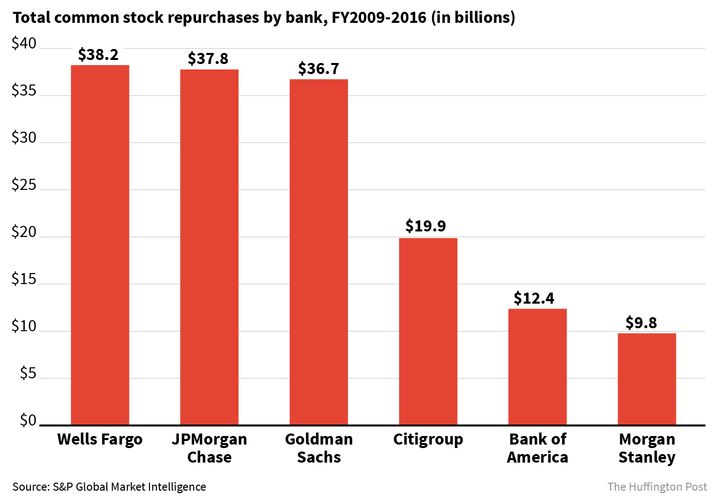
But sometimes they’d rather just buy their own stock. Since the financial crisis, the nation’s six largest banks have spent a combined $157.4 billion buying up their own stock, according to data from S&P Global Market Intelligence. JPMorgan, Goldman Sachs and Wells Fargo have spent over $36 billion each. All six of those banks declined to comment for this article.

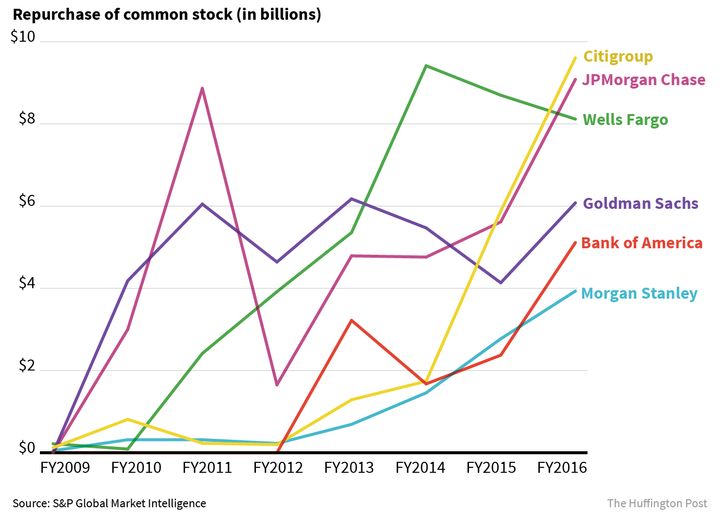
Defenders of stock buybacks argue they can be a useful corporate strategy in a weak economy. If companies can’t find a market for their products, then placating investors through buybacks isn’t a terrible use of funds until the economy turns up. Big Bank buybacks don’t fit that pattern ― they’ve expanded tremendously during the last five years of economic recovery, nearly quadrupling from $10.6 billion in 2012 to $41.9 billion in 2016.


Alissa Scheller/The Huffington Post

Dimon’s annual missives aren’t really for his shareholders ― they’re public political statements from America’s most prominent banker. In the latest edition, he noted that trillions of dollars in war spending, mass incarceration and the student debt explosion have damaged the economy. But while he didn’t offer specific policy remedies for those political problems, he did make recommendations on economic policy, arguing that excessive capital and liquidity regulations are tying up money his bank could deploy to put people to work.

Dimon called for weakening these rules, which require banks to rely on less debt and hold more cash in case of trouble. Maybe it’s true that not one dollar of the more than $9 billion JPMorgan spent on buybacks in 2016 could have gone toward making a good loan to a creditworthy business. But if so, weakening capital and liquidity rules won’t help banks get more money out the door ― the economy is just out of good lending opportunities. In that scenario, JPMorgan would have nothing productive to do with the money freed up by weakening capital and liquidity rules. The broader economy would be shouldering more risk in order to further enrich wealthy bank shareholders without seeing any increase in lending.

Big banks have a history of being reckless with buybacks. Citibank swallowed up over $7.5 billion of its own stock in 2006 and 2007, before it needed a government bailout, as University of Massachusetts Lowell economics professor William Lazonick noted in 2008. Morgan Stanley spent over $7 billion on buybacks over the same period before it too needed to be bailed out. Bear Stearns spent $6 billion before needing a government-backed rescue from JPMorgan. Lehman Brothers spent over $5 billion before missing the bailout train and going bankrupt.  

It’s one more way Wall Street fuels economic inequality.
Zach Carter is a co-host of the HuffPost Politics podcast “So That Happened.” Listen to the latest episode, embedded below: 

To listen to this podcast later, download the show on iTunes. You can also find it on Google Play MusicRadioPublic, or Acast.


GO PUBLIC

Document forgery in financial industry more common than you'd think, past employees say

Former CIBC representative says '85% of sales staff' in her workplace forged documents, encouraged by manager

By Erica Johnson, CBC News Posted: May 31, 2017 5:00 AM ET Last Updated: May 31, 2017 7:02 AM ET


'Signature falsification' was the primary allegation in 130 cases opened last year by the Mutual Fund Dealers Association of Canada. (Natalie Holdway/CBC)

About The Author

Erica Johnson
Investigative reporter
Erica Johnson is an award-winning investigative journalist. She hosted CBC's consumer program Marketplace for 15 years, investigating everything from dirty hospitals to fraudulent financial advisors. As co-host of the CBC news segment Go Public, Erica continues to expose wrong-doing and hold corporations and governments to account.
Go Public

Related Stories

Credit union employees say high-pressure sales targets turn 'members' into 'marks'
'I feel duped': Why bank employees with impressive but misleading titles could cost you big time
'Canada is in the Dark Ages': Investment insiders reveal how lax laws put your financial interests last
Bank call centre staff reveal pressure to turn customer inquiries into sales
'A very disheartening day': Most of Canada's regulators abandon plan to put your financial interests first
Ding! 4 ways banks hit customers with extra fees
Banks are businesses, you are a profit centre: Don Pittis

Employees in Canada's financial industry are speaking out about falsifying documents, telling Go Public that potentially criminal acts — like forging and photocopying customer signatures, adding initials to blank documents and using Wite-Out to conceal information — are more common than most people would think.

"It was easily 85 per cent of the back sales team doing it," says a former CIBC financial services representative, who worked in several bank branches and noted that forging signatures on documents occurred at all her workplaces. CBC has agreed to conceal her identity.
'You feel pretty awful knowing that you could have caused some serious harm to [customers] all in the name of profit for a bank.' - Former CIBC employee

The former employee, who left the bank last spring, says when she couldn't meet sales targets, her manager told her to forge customers' initials so it appeared that they had agreed to purchase insurance when they applied for a credit card, then cancel it a week or so later.

She also says a financial adviser who handled wealthy clients asked her almost two dozen times to forge customer signatures for insurance on loans, telling her his clients would never notice extra charges.

She says she finally quit because of stress and growing remorse.

"You feel pretty awful knowing that you could have caused some serious harm to them [customers] all in the name of profit for a bank."


This former CIBC financial services representative says a manager told staff to forge customer signatures to increase sales revenues and 'make the branch look good.' (Keon Chung/For CBC)

CIBC declined an interview request, but a spokesperson said in a statement that "the kind of behaviour described would be unacceptable and result in immediate termination. We take any allegation of this nature seriously and investigate thoroughly."

A financial adviser who recently left TD Bank says he often witnessed his manager copying customers' signatures onto documents using "signature cards" on file.
Been wronged? Contact Erica and the Go Public team

He himself would scribble over the dates on people's credit checks, and then black out the scribbles with thick felt pen so no one could tell he pulled an Equifax report without a customer's knowledge — a practice he says his manager demonstrated on a blank piece of paper.

"They were showing you [how to do it], they were teaching you. But they would never say that they told you to do so," says the former TD employee.

TD Bank also declined an interview but said in a statement that it takes the allegations "very seriously" and such behaviour "would be a significant breach of our code of conduct" subject to disciplinary action, including dismissal.
Cases of signature falsification on rise

In its annual enforcement report released last week, the Mutual Fund Dealers Association of Canada (MFDA) says "signature falsification" was the primary allegation in 130 cases opened last year — more than double the number of cases in 2015, and almost three times the number it investigated in 2014.

Financial consultants usually forged signatures for the client or consultant's "convenience," the report says, and the number of forgery cases has increased due to improved detection by compliance departments within financial firms.


The number of cases of signature falsification has almost tripled between 2014 and 2016. (Natalie Holdaway/CBC)

The problem of forging signatures was concerning enough for the MFDA to issue a bulletin in January — an update to similar bulletins issued in 2007 and expanded on in 2015.

It listed the deceptive methods people in the industry are using and warned against them, including copying a client's name on a document, cutting and pasting a signature, photocopying to "re-use" a signature, or using correction fluid to alter information on a document without a client's consent.

Although people in the financial industry have been found guilty of falsifying documents in recent years, few have served jail time or paid hefty fines.

"Forgery is supposed to be a criminal offence," says Stan Buell, of the Small Investor Protection Association. "But you could count on the fingers of one hand the people who have been charged criminally or sent to jail. It doesn't happen."
'It's not right to cheat old people'

Ten years ago, 97-year-old Harold Blanes says he asked his financial consultant to put about $400,000 of retirement savings into GICs — a safe investment, with no risk.

"We didn't want risk," the Kelowna man says. "We wanted our money saved, so we could enjoy it and help the kids with what they needed."


Harold Blanes, 97, says his former financial consultant doctored documents to put him in risky investments, earning her big commissions. (Gary Moore/For CBC)

Blanes says his financial consultant ignored a box he had ticked and initialled, indicating he only wanted to invest his savings for a short term. Instead, documents show that the box next to it was marked with a squiggly line — supposedly someone's initials, says Blanes — allowing the consultant to invest his money for six years.

She ended up putting it into mutual funds that tanked when the market crashed in 2008.

"She said over and over it was all in guaranteed investments," says Blanes. "And we had nothing to worry about."


'We are all doing it': Employees at Canada's 5 big banks speak out about pressure to dupe customers

After years of fighting with those managing his money, Blanes's initial investment was returned. He is now taking his financial consultant to court, estimating he has lost $136,000 in compound interest.

"It's not right at all to cheat old people out of their money," says Blanes. "I think it's disgraceful."

His son, Alan Blanes, says he thinks regulators need to crack down on financial employees who fudge documents and forge signatures.

"Dad's had 10 years of his retirement ruined by having to obsess over this case."
'They're trying to keep the genie in the bottle'

Ottawa-based lawyer Harold Geller says he is contacted by "hundreds of people a year" who say those giving them financial advice have lied, cheated and, in many cases, falsified documents and forged signatures in order to line their own pockets or boost a bank or investment firm's revenues.

Geller blames the MFDA for not taking a more aggressive approach, taking issue with the association's claim that forgery is mostly done for "convenience."


Lawyer Harold Geller says he's heard from clients who have been 'financially devastated' by forged and falsified documents. (Doug Husby/CBC)

"The Mutual Fund Dealers Association is a conflicted regulator," says Geller. "They are run by dealers and it's not in the dealer's interest to look into this issue. If there is not a complaint, [rarely] is this sort of thing looked for or caught."

Even when shady practices are caught, Geller says it can take about two years to reach a settlement; five years if the case goes to court. Either way, he says, investors are often muzzled by a confidentiality agreement.

"I think that they're trying to keep the genie in the bottle," he says. "If more people knew about the settlements that are available, there'd be more people looking for justice."
Calls for public inquiry

In a report released today calling attention to the issue of forgery, the Small Investor Protection Association says there is "absolutely no doubt" that the practice of document falsification is widespread.

"The truth is Canadians are losing billions of dollars of their savings every year due to systemic fraud and wrongdoing by the regulated investment industry," the report reads.

4 money-saving reasons you should check your bank statements

Buell says SIPA wants a government inquiry into investor protection.

"And they have to talk to the victims — not just the industry and regulators, and people who've done studies," he says. "Forgery is indicative of the behaviour of the investment industry."

Meanwhile, the former CIBC employee who routinely forged signatures says she's relieved to have left banking.

"But I actually feel fear for some of the new people entering the industry," she says. "Because there's a very big chance that they have no idea about what they are about to walk into."

With files from James Roberts

Submit your story ideas

Go Public is an investigative news segment on CBC-TV, radio and the web.

We tell your stories and hold the powers that be accountable.

We want to hear from people across the country with stories they want to make public.

Submit your story ideas at Go Public

Follow @CBCGoPublic on Twitter

Corrections

A previous version of this story said the Mutual Fund Dealers Association of Canada issued a bulletin on signature forging in January that was an update to similar bulletins sent out in 2007 and 2010. In fact, it was an update to similar bulletins issued in 2007 and 2015.
May 31, 2017 6:27 AM ET


THE BLOG

08/05/2016 12:33 am ET | Updated Aug 05, 2016

Getting U.S. Dollars for Less: What the Banks Aren’t Telling Canadians

By Stephanie R. Caudle

The first thing many Canadians do before crossing the border is visit the local bank and exchange their hard-earned loonies for a handful of US greenbacks. While this method of converting currency comes with the advantage of convenience, it certainly doesn’t come free. Canadians actually pay a hefty premium for the privilege of doing business with a financial institution every time they need to exchange Canadian dollars for U.S. funds.

When it comes to local currency exchange, it’s important to recognize there are two sets of exchange rates. There is the Bank of Canada published rates that you can find online and in the newspaper, then there are the exchange rates your bank actually uses when you buy U.S. cash with Canadian currency. One of these things is definitely not like the other.

The lower published rates reflect what banks use when they exchange enormous sums of money amongst themselves, the rates they charge us are typically as much as 3% higher. That’s because they add in what’s known as an exchange or conversion fee, that we don’t see. This billed to cover the cost of doing business at the retail level.

Exchange rates fluctuate from one financial institution to the next and are typically set by the individual banks themselves, because the fees included in these rates are intended to offset everything from the initial expense of buying foreign currency, to the administrative costs involved in making that currency available to us through bank branches and ATMs. Banks have a lot of administrative costs.

What many Canadians don’t realize is there’s a convenient way to get their U.S. dollars for less. If you only make the occasional cross-border shopping trip, an alternative foreign exchange option might not benefit you all that much. But for anyone who frequents the States on a regular basis, or who spends a significant amount of time there when they do go, the savings potential offered by taking advantage of a foreign currency exchange service can be significant.

Foreign exchange companies, like Knightsbridge Foreign Exchange Inc., offer lump sum online exchanges at rates that are significantly less than what the big banks charge. This is great news if you exchange your Canadian funds on a regular basis, or if you exchange large amounts of money at a time: think anyone who covers their child’s American tuition, pays the mortgage on a U.S. vacation property, or is one of the millions of Canadians who travel to Florida each winter.

In the case of a company like Knightsbridge, effectively competing with the big boys means combating the banks’ huge, hidden fees with exchange rates that are as much as 1.5% to 2.5% lower - even after the firm’s low commission fee is tacked on.

“The banks have an oligopoly and don’t compete on price, we are keeping them honest and helping Canadians save,” according to Rahim Madhavji, president of Toronto’s Knightsbridge Foreign Exchange, a firm he co-founded after quitting his job at the Royal Bank of Canada in 2009.

The entire premise is based on an ability to buy foreign currency in bulk, just like the banks do. Regardless of your bank’s rate, Knightsbridge guarantees they will beat it, and they will do it while offering same-day delivery of funds through bank transfers or online bill payments.

The basic process for working with Knightsbridge involves setting up a free online account, receiving written confirmation of your exchange rate before funds are transferred, then having the converted funds sent to the desired destination. Knightsbridge is also integrated with all Canadian banks, meaning that account-to-account transfers are free. According to Madhavji, the average customer can expect to save anywhere from a couple of hundred to several thousand dollars, depending on the amount of money exchanged.

The Canadian Snowbirds Association is another service that offers better-than-bank rates through online transfers. Much like Knightsbridge, the Snowbirds buy currency in bulk, but they do it by pooling their participants’ resources each month to get better exchange rates. The Association’s monthly transfer program involves moving money from your Canadian bank account to your U.S. bank account. They then charge members and non-members alike a transaction fee to facilitate this, as well as a fee to enroll in their program.

Knightsbridge offers a monthly currency buying program too, but the firm also gives customers the flexibility to purchase U.S. dollars any day of the week. For added convenience, you can register to be notified remotely whenever the dollar reaches a more favorable level.

It may be true that the ball is firmly in the banks’ court when it comes to the setting of U.S. exchange rates, but companies like Knightsbridge are putting the power of bulk buying into the hands of the individual, and in doing so, are giving Canadians the opportunity to beat the banks at their own game.
Follow Stephanie R. Caudle on Twitter: www.twitter.com/stephrcaudle

Friday, March 17, 2017

Inequality is the Thickest Root of Most Modern Evils Including Climate Change

Inequality is the largest and easiest root that we can kill. The biggest tool we have is the Guaranteed Minimum Tax-Free Income. Social Capitalism instead of Criminal, Corporate, Military, or Neoliberal.
Nothing will happen if we don't work together for the common good. 
Remember that? The ideas of mutual benefit, egalitarianism, meritocracy, and civil responsibility. 
Of...

Equal Opportunity and Liberal Democracy

https://www.equalitytrust.org.uk/

History

The Equality Trust was launched in 2009 by Bill Kerry, Richard Wilkinson and Kate Pickett. The idea for the Trust was developed from 2007, after Kate and Richard secured a publishing deal for The Spirit Level: Why More Equal Societies Almost Always Do Better (the original hardback title) and Bill recognised the potential for a campaign based on their evidence.

In 2008 the Trust was awarded funding by the Joseph Rowntree Charitable Trust  which enabled the founders to commission a website and employ their first member of staff. The Equality Trust's launch coincided with publication of The Spirit Level on 5th March 2009.

In November 2009, a new campaign called One Society was set up by The Equality Trust and the Network for Social Change. One Society's main focus was promoting policies that would take us towards a more equal society - as well as responding to political developments relating to top pay and income inequality. In 2013, One Society was fully merged into the Trust.

The Trust obtained charitable status in May 2015 and continues to be funded through a combination of charitable trusts and support from many generous individuals and organisations for which we are very grateful.

he UK is a divided society where the richest receive the lion’s share, leaving crumbs for the rest. How did we get to this point? What are the costs of having such high inequality? And what do people think we should do about it?


How is economic inequality defined? How unequal is the UK? How has UK inequality changed over time?

What factors have led to this increase in inequality in the UK?

How does inequality affect the individual, society and the economy?

What do people think and know about inequality?

The most up to date research on economic inequality, its causes, and its effects.

Why is equality better for everyone?

Local Groups

The Equality Trust works with numerous affiliated local groups up and down the UK and across the world, carrying out awareness-raising and campaigning work to reduce economic inequality.
Find Local Groups

View UK Groups

View International Groups


We have always believed that to reduce economic inequality, a social movement demanding change is necessary. Local groups play an absolutely vital role in making that movement a reality. In their own words, here's why some of our excellent local group members got involved:

​“More than anything, The Equality Trust ignites and fosters the realisation that, even alongside the everyday demands of life and work, we can have a real and meaningful effect on our local area, and as part of a greater nationwide movement for a fairer society. Our relationship with the Trust has shown us that a great deal can be achieved, not through time or money, but with simply the motivation to make change happen.” - Adam, Colchester Equality

"The reason for being a member is simply that we have such institutional and ingrained inequality in Britain and elsewhere today and Equality North West and The Equality Trust provide opportunities to work against such a pernicious situation. I get to spend time working with fundamentally decent human beings who aren’t entirely motivated by their own self-interest and I do it because it makes a difference." - Various members of Equality North West

"You've got to be a passionate person and believe that you can make a difference. I feel I'm educating people about inequality. Despite frustrations I feel I'm achieving something when I talk to people on the stall, even if I change just one person's view." - Pam, Bromley Income Equality Group

If you would like to campaign for greater equality in your local area or region and are interested in doing so with other like-minded people, please get in touch with our Supporters & Affiliated Local Groups Manager, Bill Kerry, at bill.kerry@equalitytrust.org.uk and he will put you in touch with other active supporters in your area.

International Groups

Argentina

Julieta Elgarte
julielgarte@yahoo.com.ar

Austria

Dr. Georg Hubmann
georg.hubmann@jbi.or.at
Visit our Website

Canada (Toronto)

Benjamin J. Trister
ben@benjamintrister.law.pro
Visit our Website
Follow us on Twitter
Like us on Facebook

Canada (Vancouver)

Justin Veuthey
justin.veuthey@gmail.com

Chile

Fabiola Cabrera
fabiola.cabrera.v@gmail.com

Germany (Munich)

Catherine Lodge
c-a.lodge@t-online.de

Hungary

Samantha Cheesman
samantha@juris.u-szeged.hu

Italy

Elisabetta Rossi
betta@i-qualitygroup.org
Visit our Website
Like us on Facebook

Kenya & East Africa

Joseph Mbugua Githae
jmgithaemurata@gmail.com

Malawi

Simon Gondwe
lifewithapurpose2014@gmail.com

Netherlands

Marjan Leneman
marjan.leneman@tele2.nl

New Zealand

Nick Jennings
nick-jennings@paradise.net.nz
Visit our Website

Portugal

Filipe Morais
filipemmorais@hotmail.com

South Africa (Cape Town)

Adam Bertscher
abertscher@gmail.com

South Africa (Plettenberg Bay)

Dr Mark Marais
neander@absamail.co.za

Sweden (Gavle)

Kristina Palm
kristinapalm1@gmail.com

Switzerland

Balthasar Glaettli
balthasar.glaettli@gmail.com

Turkey (Istanbul)

Hülya Baylan
hulya-baylan@hotmail.com

USA (California)

Leslie Lewis
lewis.r.leslie@gmail.com

USA (Connecticut)

Richard Duffee
richard.duffee@gmail.com

USA (Oregon)

Bob Goldman
bobgoldman@comcast.net

USA (Tennessee)

Darron Smith
darronsmith@me.com

https://www.equalitytrust.org.uk/affiliate-us

Affiliate To Us

The Equality Trust welcomes affiliation from organisations or groups (both incorporated and unincorporated) that wish to be fully informed about all aspects of economic inequality and how it affects the society or sector in which they operate (our affiliation scheme complements our supporter scheme for individuals which can be found here).
We welcome applications from the worlds of business, trade unions and the public sector as well as from civil society, including co-ops, charities and social enterprises as well as campaign groups. To affiliate please complete this form and return to us either by email or post.
As an affiliate, you will automatically:
  • Have direct access to our research team to discuss the latest data, evidence and research relating to inequality as it affects your areas of interest.
  • Receive copies of all our publications, in various formats, free of charge.
  • Be invited to at least one affiliates-only briefing and networking event each year with expert speakers.
  • Receive priority invitations and free entry to our high-profile events.
  • Have your logo listed on our affiliates page (which will link to your website when clicked).
  • Receive a number of our egalitarian badges.
Sponsorship Opportunities
Affiliates can also sponsor different aspects of our work at competitive rates, including our:
  • Newsletter - our informative, regular newsletter goes to thousands of people every month, including many prominent politicians, journalists and policy-makers as well as academics and commentators.
  • Reports - our well-respected reports on issues relating to inequality also go to our entire mailing list as well as being transmitted to our growing social media following. Our reports receive regular and widespread press and media attention across print and digital formats.
  • Website - our website typically receives over 50,000 views a month from over 20,000 users. Our affiliates can sponsor our entire website or sections of it such as the influential and widely read “About Inequality” section or our popular Local Groups section.
  • Social media - our very active twitter and facebook pages reach tens of thousands of people including many influential people and organisations.
  • Events - our flagship events Local Groups Day (summer) and Annual Conference (autumn) as well as other opportunities throughout the year are available for sponsorship. We very much welcome discussions around sponsored donation of venues or services in relation to events.
Partnership Opportunities
For those affiliates seeking a more in-depth relationship, we welcome discussions around the sponsorship of staff positions to produce original research into particular areas of interest relating to inequality. We can also provide affiliates with bespoke education and training on matters relating to economic inequality, equality and diversity for your staff, members or other stakeholders. We can also provide speakers for your events, including our Executive Director and various Trustees. These services will be provided at a competitive cost to suit your budget.
For further details about affiliation, sponsorship or partnership with The Equality Trust, please contact our Executive Director, Dr. Wanda Wyporska, at wanda.wyporska@equalitytrust.org.uk


Staff Members

Executive Director
Dr Wanda Wyporska is Executive Director of The Equality Trust and was awarded a DPhil. from the University of Oxford, where she was a  Starun Senior Scholar. She previously led on equalities at the Association of Teachers and Lecturers (ATL) and also worked at the TUC.

Media and Communications Manager
John Hood is Media and Communications Manager at the Equality Trust. John previously worked at the Liberal Democrats' Policy and Research Unit.

Supporters and Local Groups Manager
Bill is a co-founder of The Equality Trust and looks after our supporters and affiliated local groups. Previously, Bill worked as a Company Secretary across the private, charitable and social enterprise sectors, a role he now performs for the Trust as well. He is also a Non-Executive...

Public Affairs and Campaigns Manager
Lucy Shaddock is Public Affairs and Campaigns Manager at the Equality Trust. She holds an MSc in Public Policy from University College London and previously worked at the Institute for Government.

Finance and Operations Manager
Jo is part-time Finance and Operations Manager for the Equality Trust, having previously worked at The Judith Trust. Jo is also a Breastfeeding Counsellor and holds an MSc in Gender Studies.

Board Members

Chair of Board
Sean Baine is Chair of the Board.

Co-founder and Board Member
Kate trained in biological anthropology at Cambridge, nutritional sciences at Cornell and epidemiology at UC-Berkeley, and is currently Professor of Epidemiology in the Department of Health Sciences at the University of York. She co-founder of The Equality Trust and is co-author of The Spirit...

Board Member
Judith Moran is the Director of Quaker Social Action, an East London charity which supports people on a low income to find solutions to the issues affecting their lives.

Board Member
Tom is responsible investment co-ordinator at the International Transport Workers’ Federation. This is a recently created post to support trade union work in the capital markets in Europe. Prior to this he was Head of Communications at PIRC, and previously was a senior policy officer at the...

Co-founder and Board Member
Richard has played a formative role in international research on the social determinants of health and on the societal effects of income inequality. He studied economic history at LSE before training in epidemiology. He is Professor Emeritus of Social Epidemiology at the University of Nottingham...

Board Member
Zoe Williams has been a columnist on the Guardian since 2000 - previously, she wrote a column for the London Evening Standard.  She has appeared on various current affairs and discussion shows and written for a load of magazines. She was 2013's Print Journalist of the Year for the...