Featured Post

Me and My Mission

Showing posts with label Philosophy. Show all posts

Wednesday, April 19, 2017

The Global Civil War: The Enlightenment, Nationalism, Anger, Inequality, IS, and Trump


 Age of Anger by Pankaj Mishra
Age of Anger: A History of the Prestent by by Pankaj Mishra, published by Farrar, Straus and Giroux, 2017.

Why is the world so angry?

These three programs from CBC Ideas help weave together the threads that reveal the answer.

Tuesday April 18, 2017

Globalized Anger: The Enlightenment's Unwanted Child

Trumpism. Hindu nationalism. ISIS. Chinese expansionism. People everywhere seem fed up with the status quo, and their anger and intolerance are finding political expression. But why? Pankaj Mishra believes that the current unrest isn't about any so-called "clash of civilizations" between the enlightened and unenlightened. He thinks the globalized anger is the legitimate offspring of the Enlightenment itself. He speaks with Paul Kennedy about his provocative book, The Age of Anger: A History of the Present.
"We should really look at the modern world as constituted by sameness and similarity rather than religious, cultural, theological difference. Obviously, people make all kinds of claims for their cultural and theological differences, whether it's members of Islamic State, or whether it's Christian fundamentalists or white nationalists, who are very insistent that their, race their religion, their nation, is unique and they are speaking on behalf of that -- on behalf of a particular tradition.

But I think the task of the interpreter is to go beyond these statements, not take them at face value. And to see what are the ways in which these supposedly disparate and diverse peoples are connected. What is the experience they are responding to, and what is their worldview, their particular makeup? And this is where I think terrorism, for instance, has always been a universal phenomenon. And behind that lies the temptation of violence as a kind of aesthetic, as a kind of existential experience -- and you see that right from the 19th century onwards, as a way of asserting your individual self, as a way of empowering yourself. And we see that again and again in modern terrorism, whether it is the man, Omar Mateen, who in Florida was constantly Googling himself, even while he was killing people: he was trying to see what people were saying about him. This kind of exhibitionism -- this is an attempt to find yourself, and to become famous, and to be celebrated by other people.

Terrorism, in almost all cases, is not separate from the way we live our lives today, in the ways in which we think of ourselves and the wider world. And I try to make this clear in a variety of ways, including describing this friendship that sprung up between Timothy McVeigh and Ramzi Yousef, the first man to try to blow up the World Trade Center. They found themselves in adjacent cells in a supermax prison in Colorado, and discovered that they had far more in common with each other than with anyone else around them. In fact, Yousef is on record as saying that: 'I've never met anyone who was more like me.' And this is a man who had spent most of his life moving through networks of various fanatics and radical Islamists. So it's really important to see how there are all these psychological affinities, emotional makeup, that connect these diverse figures --  and how this experience of powerlessness, experience of humiliation, the desire for vengeance connect all these different sorts of figures.

We have to move away from thinking of terror or violence as being specific to a particular religious community, or a particular part of the world. We have seen this over and over again erupt in all parts of the world. And we have to locate the sources of this violence in specific social, economic factors: we cannot really bring in religious scriptures, or indeed stereotypes about religious communities into our frameworks of analysis. If we do that, we are making a huge mistake."


​Pankaj Mishra is a London-based Indian writer and thinker who has written widely on history, politics, and literature. Age of Anger: A History of the Present is his ninth book. It's published by Farrar, Straus and Giroux, 2017.

Further reading:
  • America At War With Itself by Henry Giroux, published by City Lights Books, 2017.
  • The View From Flyover Country by Sarah Kendzior published by Amazon Digital Services LLC, 2015.
  • How Will Capitalism End?: Essays on a Failing System by Wolfgang Streeck published by Verso, 2016.

**This episode was produced by Naheed Mustafa.

Wednesday April 19, 2017

Drone Warfare: Is Killing Terrorists Legal?


An MQ-9 Reaper remotely piloted aircraft (RPA) flies by during a training mission at Creech Air Force Base on November 17, 2015 in Indian Springs, Nevada. The Pentagon has plans to expand combat air patrols flights by remotely piloted aircraft by as much as 50 percent over the next few years to meet an increased need for surveillance, reconnaissance and lethal airstrikes in more areas around the world.

An MQ-9 Reaper remotely piloted aircraft (RPWolfgang Streeck on the various ways citizens living in the post-capitalist interregnum will behaveA) flies by during a training mission at Creech Air Force Base on November 17, 2015 in Indian Springs, Nevada. The Pentagon has plans to expand combat air patrols flights by remotely piloted aircraft by as much as 50 percent over the next few years to meet an increased need for surveillance, reconnaissance and lethal airstrikes in more areas around the world. (Photo by Isaac Brekken/Getty Images)
Listen to Full Episode 53:57
On 30 September 2011, American military drone operators at an Air Force base in Nevada spotted Anwar al-Awlaki in northern Yemen. The radical Muslim cleric -- and American citizen -- was in a desert more than 13,000 kilometres away, sitting near an SUV. Awlaki spotted the drones and ran to the vehicle. Back in Nevada, an operator clicked a button. And within seconds, two Hellfire missiles blew the SUV to smithereens. In Objective Troy, Scott Shane examines the rise of an American radical cleric and President Obama's decision to have him killed.  **This episode originally aired May 11, 2016.


  "This is part of a generational conflict between the US and the West - and Canada - and a certain strain of Islam. And I think it is going to play out for many years to come. I wouldn't have said this a few years ago, but I think with the rise of ISIS and the tentacles of ISIS turning up in Western Europe, and indeed in Canada and the US, that we are in for a long drawn out conflict. And I think that Anwar al-Awlaki will remain a central figure, a central propagandiste all over the English-speaking West, and indeed since many of these videos are now put up in translation in many other languages as well." -- Scott Shane

Objective Troy: A Terrorist, A President, and the Rise of the Drone is published by Tim Duggan Books.


Scott Shane - 2016 Gelber Prize Winner
Scott Shane is awarded the 2016 Lionel Gelber Prize for his book "Objective Troy: A Terrorist, a President, and the Rise of the Drone"

Scott Shane covers national security issues for the New York Times and is this year's winner of the prestigious Lionel Gelber Prize. The award is given to the world's best non-fiction book in English on foreign affairs.
The Lionel Gelber Foundation awards the prize in partnership with Foreign Policy magazine and the Munk School of Global Affairs, at the University of Toronto.

** This episode was produced by David Gutnick.

Thursday February 09, 2017

Surviving Post-Capitalism: Coping, hoping, doping & shopping

Poster of video clip
Listen to Full Episode 53:59
The signs are troubling: the ever-widening chasm between the ultra-rich and everyone else. Mass protests. Political upheaval and social division. It looks as though the rocky marriage between capitalism and democracy is doomed, at least according to Wolfgang Streeck, who directs the Max Planck Institute for the Study of Societies in Cologne, Germany, where he is also a professor of sociology. In conversation with Paul Kennedy about his book How Will Capitalism End?, he makes the unnerving case that capitalism is now at a point where it cannot survive itself.


How Will Capitalism End? by Wolfgang Streeck
(Verso Books, 2016.)
According to Streeck, capitalist societies are entering an interregnum -- a pause or suspension of normal governance -- as the system of capitalism collapses in on itself. In the absence of countervailing forces to keep it afloat, capitalism has essentially devoured itself. One consequence is a loss of state solidarity citizens in western countries have become used to. Streeck points to Italy, Greece and Spain, countries where young people can't get find jobs; where fewer people can live on their own; and where marriage and birth rates are declining. People everywhere are now trying to protect what little they have left.

Wolfgang Streeck sees day-to-day life in the interregnum in stark terms: coping, hoping, doping, and shopping. He says that when it comes to the harsh realities of the interregnum, those who cope well will wear their stress as a kind of badge of honour. Those who cope poorly will mask their inability with drugs and mindless consumerism.

Democracy vs. Capitalism

"Democracy was always a problem in a capitalist society. There's an enormous inherent tension between the two. Democracy is inherently egalitarian because every citizen has one vote. And the rich also have one vote but the rich are only five percent. Whereas in the market, every dollar has a vote. And the capitalist economy in particular functions according to -- I think it's [the Gospel of] Matthew -- where it says he who has will be given [more]. And he who has [little] will have even what he has taken away...

And where you have capitalism and democracy at the same time, you have a contest between these two principles of distribution: egalitarian versus inegalitarian. This is why democratic politics have always tried to intervene in the markets and tried to contain the "Matthew effect". You can also call it cumulative advantage if you want a more elevated term. So, where you have democracy in the form of trade unions, centre left political parties, sometimes centre right political parties, Catholic parties, and so on -- they look at the market and what comes out of the market and then they become concerned both about their capacity to get re-elected and about principles of justice which, in a democracy, are principles of social justice, not market justice."

Coping to Death

"Coping is an attitude or an activity whereby people who lack traditional support -- either from families or from social services -- work very hard to cope with increasing pressures on their everyday life.

And you can observe this in lots of studies on family life in the United States and Europe, where two people work full-time, they try to raise two children, they live a very sort of regulated, exhausting life in order to meet all the contingencies that hang together with competing in the labour market -- caring for others, caring maybe also for their parents, in a world in which external help is increasingly less available.

Now what I observe in ethnographic studies is that people actually can become proud of their ability to exhaust themselves in this struggle. So that they say we are coping, we're good, and others are less good or bad at coping. So it becomes a matter of pride to subject yourself to this rigid discipline imposed on you by the market."

Nuclear-Proof Apartments

"[In] The New Yorker, there was an article on survivalism among the American very, very rich. In my book, I envisage a situation in which inequality becomes so big that something happens that has never happened in society before in the history of human societies. That is, that the elites of society lose interest in the society as a whole because they can survive on their own.

Someone, for example, buys the silo of an intercontinental missile which is hardened against nuclear attack, and deep in the ground builds apartments that he sells within a matter of a few weeks to New York financial billionaires, tech billionaires from California, who all buy one of these apartments because they are afraid of the breakdown of social order, and of people taking guns and trying to go after them.

I think these people are not so unrealistic. I don't think they are obsessed. They see better than most others the decaying body of a system that can no longer keep itself together. I take this as a very interesting example of what I thought when I looked at the increase in inequality in our societies that we could be facing the moment when those who absorb and extract all the resources from these societies begin to think that they can dissociate themselves from it and live their own lives."

**The New Yorker article: "Doomsday Prep for the Super-Rich"

The Coming Age of Uncertainty

"As a sociologist, I think we have to think very seriously about transitions in the structure of our societies. I happen to have come to the conclusion that we are facing a fundamental transition in modern societies, modern capitalist societies. And I feel that these societies have exhausted the capacity to build a framework, a social framework, around the hot core of capitalist profit-making -- so that we will see signs of social disintegration all over the place in unexpected, surprising ways, in a period in which we lose control and governance and orientation, and we'll live in an era of great uncertainty."

Further reading:
  • How Will Capitalism End? by Wolfgang Streeck, published by Verso Books, 2016.
     
  • PostCapitalism: A Guide to our Future by Paul Mason, published by Allen Lane, 2015.
     
  • The End of Alchemy: Banking, the Global Economy and the Future of Money by Mervyn King, published by W.W. Norton, 2016.
Related websites:
**This episode was produced by Naheed Mustafa.

Saturday, October 8, 2016

#Compassion and #Selfishness, Firmly Defining #Good and #Evil


Only compassion defeats selfishness.

The genetic drive to survive and propagate makes every animal selfish, individually and/or as a group. Children are born selfish unable to see others as having any value beyond serving their needs and seeing their needs as paramount. However, child like many animals can grow and be trained to recognize the value and needs of others as equal to their own, to see the value in building up others instead of just themselves and the value of willing cooperation (as opposed to coerced by others or enforced by genes such as with ants or bees) over ruthless competition, and to recognize that by exercising compassion towards self and others, you build strength in all. Those who remain selfish turn toward as dehumanization, devaluing the existence and needs of others to serve their own. Compassion is the source of all virtues, selfishness the root of all seven Deadly Sins. Compassion is goodness, selfishness is evil.

When I wrote the following I used the term dehumanization as way to get at evil, but I have since come to realize that dehumanization is inadequate. Too narrow and doesn't get at the root. Dehumanization is the inevitable result of selfishness, putting oneself about all others. However, the rest of this still stands:


Life without defined meaning has no clear purpose and little potential for happiness, just survival.

This is an attempt to establish a stable foundation acceptable to both religion and philosophy simple enough to not pose inherent conflicts and to allow no room for equivocation or misinterpretation, yet applicable to all ethical situations and questions as part of an ethical framework.

I am trying to find a better, clear definition for Good and Evil. If you aren't clear on what they mean, how can you begin to judge the balance of your actions. How do you know when you are Good? If  it's all relative, there is no morality, just opinion. It is not just benefit or detriment, positive versus negative, because both are often present at the same time. One action can produce both effects in varying proportions and an intended benefit can become an unintentional detriment. "The Road to Hell..." and all that.  Because we base everything, particularly religion, culture, laws, and politics, on these ideas, they should be better understood by all. A lack of clear definition results in a fog of confused communication that generates frustration and anger, making matters worse. Assigning different sounds and meanings to the same Latin  and Arabic symbols is what began to differentiate many European languages, for example.

It has been the historical norm that anything we view as less than human gets abused, exploited, or destroyed. No one and nothing is less than human. Composed of tiny parts, the universe and most things in it are far greater in comparison with a human. We are all insignificant and vital. Even the food-chain isn't a true hierarchy. Apex predators are continually being eaten alive, and pooped on, by external and internal microbes without which we can't survive. Ecosystems are symbiotic. Everything depends on everything else. A single reproducing virus can wipe out every lion in the world. It could take us down long before all the lions could. Everything is essentially equal and always greater in combination. Every design element, worker's touch, screw, cog, spring, fiber of wood, and particle of plastic, contributes to the orderly operation of the machine.

Only we have the arrogance to believe otherwise. To believe ourselves gods in fact, not in potential. We have dehumanized each other and the natural world in our minds and are on our way to dehumanizing the planet, literally, in fact. That's Evil.

Regardless if you’re Christian, Jewish, Muslim, Buddhist, Taoist, animist, druid, or atheist, when you call for the harm of innocents, you commit to the satanic faith in terror and control. Calling for purity of ethnicity, nationality, ideology, or religion, is a cornerstone of evil. The only truly pure thing is compassion. Only compassion defeats dehumanization, stemming the flow of bodies fuelling the death in search of meaning, purpose, and purification.

Different from empathy and sympathy compassion is the strength to be willing to try and ease someone's suffering, to help them hold on and eventually stand up, or to let go at the end, yourself included. Equality, love, forgiveness, and peace, all require compassion to be real and lasting.
Compassion defines Goodness and is its foundation. Dehumanization defines and is the root of all Evil. One is not the absence of the other or the opposite. They can't get confused and are definitely not relative to perspective. Our present definitions of good and evil are far to fuzzy and relativistic.

A truly consistent moral philosophy  must be grounded on firm, absolute, principles. Its foundational axioms must be stable to bear the weight of life. Good and evil have no shades between them. The move toward evil is a reduction in the wiliness to be compassionate. It is active resistance just as dehumanization is active. Good person doing nothing, staying silent, or being willfully blind, is a choice to restrain their compassion. A choice not to act. A hardened heart cannot beat. Psychopaths biologically lack compassion, born, made, or taught evil. But many more develop it through choice and practice. To become evil you have to actively turn away from good.

You can turn back. It's your choice.
A dehumanizing act can't generate compassion, it only reduces it. Thus the ends never justify the means. There is no "lesser" evil, no shades of dehumanization, only degrees of unwillingness to be compassionate. Dehumanization is never good and compassion is never evil.

Compassion isn't positivity, but it is positive. It isn't patience, tolerance, understanding, kindness, charity, or love. It is their basis and only hope of development. Dehumanization isn't negativity, it is the destruction of care and respect for life and its constituents. That makes it negative.

Dehumanization is necessary only for war, slavery, murder, assault, rape, theft , and exploitation (etc.). There is no necessary evil. Compassion is never competitive with itself. There is is no rivalry of goods, just a common good.

Quantum physics reveals that observation influences, potentially defines, what is observed. It seems there are no particles, only forces, until we observe their speed or position.  It needn't require human observation, the perception of any existent thing might be enough. A atom's "awareness" of neighboring atoms as a result of interacting or common forces and exchanged particles for example. Some form of elementary communication. Quantum particles can even be entangled so that a change in one causes the same change in the other at the same time. "Spooky action at a distance."

Engaged awareness matters and has an effect, even across apparently vast divides of space and time.

A firm definition of good and evil may also clear up other relative terms, ones that you recognize only when you see them. Dehumanization is obscene. Obscenity is the expression of dehumanization, without compassion. Art uses dehumanization in it its  techniques and images to objectify and reveal the dehumanization and subject in order to build compassion, not  reduce it. Art is communication not exploitation. The medium, tool, technique, image, object, or subject, is less than human but speaks to humanity in order to explore, reveal, and development. It can be pleasurable, entertaining, provoking, or horrifying but isn't obscene or evil unless it lacks compassion.

Beneficial drugs are compassionate in use, though can become toxic in the wrong dose or chemical circumstances. They help the person hold on and eventually stand up, if possible. Their unfortunate side-effects are problems in delivery, targeting, and the complexity of the compounds, not because they are good or evil substances. Toxic drugs and addictions dehumanize those affected.

Hunting as a game is evil. Hunting as a respectful part of a natural life can be compassionate. 

Pain and pleasure aren't good or evil in themselves. Pain can draw awareness, encourage compassion, and enable healing. Pleasure gained from dehumanization isn't good. Justice is compassionate, revenge is dehumanizing. Punishment must be compassionate or it becomes torture. Peace without compassion is tyranny. Good comedy hits us in the face with life's absurdity. Laughter is how we cope, an expression of compassion for the absurd. A good tragedy does the same from the opposite point of view. Fair-use and free-trade without compassion is exploitation.

Compassion informs beauty and dehumanization ugliness, the rest is just appearance and perception.

Look in the mirror. What do you see staring back from under the surface? Are you better able to judge the balance of your actions?

Only compassion defeats dehumanization.

Selfishness is the root of all evil. Compassion is the source of all good and grace. Selfishness weakens all involved, dividing with fear that becomes hate. Compassion strengthens giver and receiver while uniting both in hope. Selfishness creates the view that only the self is human and "dehumanizes" everyone and everything else. Compassion recognizes the value inherent in every life as equal and sees the self's humanity in reflected in others. By hurting others you hurt yourself and by helping others you help yourself. Self-care is the self compassion required to be able to help others and is not selfishness. You need to be healthy yourself to be able able to be compassionate to others. When you are in pain, you can't only think of yourself, that's natural.


Compassion is constructive and cooperative; the giver building strength by helping to lift up another being to the same level so that both may rise higher. One boosts the other in turn, each making up for what the other lacks. If one falls the other catches them and helps them hold on onto they can find their footing. Together they progress to the top. Selfishness is competitive and destructive, seeking to raise the self by knocking down or climbing over others. Each seeks advantage over the other and fears giving anything away lest they join the mass of losers knocked to the bottom. The selfish hoard their advantage and reach the temporary goal first but waste and devalue the effort of everyone else.  Only they are worthy. They can only see their own point of view and reflection in others. They fear that others are like them and will knock them to the bottom as readily.  Placing themselves on a pedestal they project their own insecurities and failings upon others to protect their precarious perch and judge all others by their limited experience, often being most harsh when they see their own sins in others. The compassionate see the potential for themselves to also fall and are recognize that no one is without sin. They seek to understand not condemn, to help not punish, to heal not harm, to build up rather than break down. 

The selfish can't build or negotiate because that takes cooperation and compromise, compassion for the position of the other. Driven by fear they can only divide in hope of climbing to the top of their competitive pile. Fear becomes anger and hate. The selfish compete to be the winner with all but one ending up losers. The compassionate cooperate and everyone wins. 

One of the problems with the concept of altruism is that its supposed to be selfless. The argument comes up that it is actually selfish because doing good make s you feel good so it's not selfless. Compassion gets around this. Feeling good because you are being compassionate is just showing compassion for yourself. It is the reward for doing something positive that reinforce the behaviors thus strengthening your compassion. A virtuous circle.

Life is a school where we are challenged to learn to use our free will for compassion instead of selfishness, compassion for ourselves and others. In my theological understanding the degree of success you achieve in learning this determines the amount of responsibility with which you will be entrusted in the existence that comes next, whatever form that may take. The important thing is doing our best to fulfill our life's purpose here and now. It's all we have. If we don't make it a compassionate world it will become a dehumanized one. It's up to us.


 From CBC Radio's The Sunday Edition:

Sunday October 09, 2016

The Meaningful Man


Viktor Frankl wrote “Man’s Search for Meaning” in nine fevered days. Tens of millions of copies have been sold in more than 30 countries. (Getty Images)

Listen 50:53

A chronicle of survival and a call to life, Viktor Frankl's Man's Search for Meaning continues to change people's lives generation after generation. The book is part memoir, part manifesto, and part discourse on human psychology. Written in 1946, after Viktor Frankl survived four Nazi concentration camps, including Auschwitz, Man's Search for Meaning describes how he endured the camps, and how to find meaning in the face of suffering.  
Seven decades after it was first published, it continues to inspire readers.
Chris Martin
Chris Martin says “Man’s Search for Meaning” has had a profound influence on his music. (AP/Matt Slocum)
Chris Martin, the British rock musician from Coldplay, held it close during some personally challenging times.
Mohamed  Fahmy
Canadian journalist Mohamed Fahmy used "Man's Search for Meaning" to help him endure pain, fear and loneliness during his imprisonment. (CP/Fred Chartrand)
Mohamed Fahmy, the Egyptian-born ­Canadian journalist, discovered it during 400+ days in Cairo's Scorpion prison.
Anna Redsand
Anna Redsand was inspired to write the biography, “Viktor Frankl, A Life Worth Living” when she saw how Frankl’s book helped kids who felt their lives were without hope.
Anna Redsand wrote a biography of Frankl geared for young readers, when she discovered that the book spoke to the adolescents she works with in Albuquerque, New Mexico.
In this special hour about Man's Search for Meaning (originally broadcast in April 2016), we explore the ongoing resonance of one of the most influential books of the  twentieth century. 
We meet Viktor Frankl himself, in an interview with Roy Bonisteel of CBC television's Man Alive.
Media placeholder
Man Alive: Viktor Frankl21:15
We meet Donna Johnson, who visited Frankl's widow, and the room where the book was written; Rob McCormick, who uses the book's message in his work on Indigenous healing; Stephanie Sliekers, who Michael Enright met on a busy Toronto streetcar and for whom Man's Search for Meaning has been a cancer survival tool; and Viktor Frankl's biographer, Haddon Klingberg.\
Dr. Balfour Mount, the father of palliative care in North America, invited Frankl to Canada for his last visit here, and continues to be influenced – personally and professionally – by his ideas.

The following comes from BBC Earth. I have a suggestion for the philosophers struggling to find a better word than "Altruism" and it isn't "pro-sociality". There is such a thing as true compassion. Evolution uses random genetic mutation creating trade-off and mixed effects. Not all traits are beneficial or successful adaptions. Some are leftovers or mistakes that got carried along, like a genetic disorder or disease. Compassion is socially and individually beneficial, strengthening both beyond the cost.

There is no such thing as a truly selfless act

It is another peaceful day on the savannah. Herds of buffalo mill around, chewing the cud and flicking their ears to keep the flies at bay. On their backs, tiny oxpecker birds hop here and there to remove tiny skin parasites, unnoticed by their large hosts.
But there is a dark undertone to this tranquil scene. Closer examination has revealed that oxpeckers do more than simply clean their hosts' skin. Some of them are poking away at open wounds and feeding on buffalo blood.
It seems like even this famous symbiotic arrangement between large herbivores and grooming birds is hampered by organisms' inherent tendency to be selfish.
In fact, this might be a general rule. Mutualistic interactions in nature are often regarded as unstable, precisely because one partner will generally take advantage of the other given half a chance.
This suggests that selfishness is a dominant force in nature; an inevitable symptom of the "survival of the fittest" mantra. So is there any such thing as a truly selfless act? And how should we interpret human acts of charity?
Darwin was a diligent thinker. He agonised over any example he came across of organisms behaving in a way that seemed to run counter to his idea of evolution through natural selection. He soon recognised altruism as "one special difficulty, which at first appeared to me to be […] fatal to the whole theory".
"He who was ready to sacrifice his life," he fretted in The Descent of Man, "would often leave no offspring to inherit his noble nature." How can genes for selflessness propagate if the heroes carrying them spend more time doing good deeds than ensuring their own survival?
Not only are these animals placing the safety of others above their own, they are playing with very high stakes
All sorts of animals seem to be capable of acts of kindness. Primates groom their peers, birds warn each other when they see a predator, and African wild dogs will look after pups belonging to their fellow pack members.
These altruistic behaviours do not necessarily carry a significant cost in terms of an individual's chances of survival, but some other examples do.
Take Belding's ground squirrel. This rodent is found in the mountains of the north-western US, where it lives in sociable groups and provides a delicious snack for various birds of prey and predatory mammals.
When a predator approaches a colony of ground squirrels, the individual who sees it will delay fleeing in order to emit a series of noises, alerting its fellows to the imminent danger.
This is exactly what concerned Darwin. Not only are these animals placing the safety of others above their own, they are playing with very high stakes. Research has demonstrated that making certain calls increases the likelihood of an individual ground squirrel ending up as lunch.
About 100 years after Darwin first published his theory, biologists finally formalised a hypothesis that could explain such baffling behaviour.
Alarm calls are in fact a function of entrenched nepotism in squirrel society
A potentially apocryphal story helps explain the basis of this hypothesis. When J.B.S. Haldane, co-founder of the "modern synthesis" of evolution, was asked if he would throw himself into a river to save his brother, he replied: "No, but I would to save two brothers or eight cousins."
This is the concept of kin selection, which was formalised in 1963 by the highly influential biologist W.D. Hamilton.
According to Hamilton, the altruistic behaviour of an individual ground squirrel is easy to explain when the selfless act is put into its proper context. One animal might be prepared to sacrifice its life – and its ability to reproduce – in order to raise the chances of its relatives surviving and breeding.
Relatives share many of your genes, so they can be considered as proxies for your own evolutionary success and – as per Haldane's statement – the closer the relative, the better.
Kin selection might explain the most extreme form of self-sacrifice in nature: eusociality
Ground squirrels, it turns out, are a textbook example of kin selection.
Paul Sherman, a researcher at Cornell University, spent three years in the 1970s monitoring populations of ground squirrels, paying particular attention to their familial relationships. His conclusion was that alarm calls are in fact a function of entrenched nepotism in squirrel society, with individuals more likely to emit them if there are relatives nearby.
Hamilton also suggested that kin selection might explain the most extreme form of self-sacrifice in nature: eusociality.
The average honeybee, ant or termite has pretty limited options in life. They inhabit highly cooperative colonies where, unless you are queen, you must pay the ultimate evolutionary price: your reproductive ability. The societies these animals form are what biologists call "eusocial" ones.
Since Hamilton, kin selection has been the most popular explanation for this counterintuitive phenomenon, although there have been various modifications to his original proposal. The fact that ants in the same colony are all sisters explains why one member might sacrifice her reproductive capacity, and even her life, for the good of the colony.
A vampire bat cannot go for more than 36 hours without a meal
Arguments have been traded back and forth over whether or not eusociality results from kin selection alone, and indeed over how significant kin selection is in general.
But whatever the conclusion, the idea of genetic ties lying at the heart of selfless behaviour is now an important tenet of evolutionary biology.
However, there is another key theory concerning altruism that has proved rather more contentious.
In 1984 Gerald Wilkinson from the University of Maryland, USA, reported on food sharing in vampire bats. This is a fairly disgusting process that involves bats regurgitating blood into each other's mouths, but it is also a necessary one. A vampire bat cannot go for more than 36 hours without a meal, so regular food sharing can save some animals from starving.
Wilkinson's observations were of note because while the bats do live in groups with other family members, they were preferentially helping those who were the hungriest, not just those with whom they shared genes.
What Wilkinson had uncovered was the best example to date of a concept, previously proposed by eminent evolutionary biologist Robert Trivers, known as reciprocal altruism.
Reciprocal altruism is a model wherein animals help unrelated individuals and accept a short-term loss if it means a long-term gain. So if a starving bat is helped by a well-fed one, the action is done because of some deep, unconscious instinct that in the future the tables might be turned: today's starving bat might be tomorrow's well-fed one.
This suggests that all forms of altruism evolve for selfish means, at least in terms of the survival of genes
"You can think of this as 'social capital' – when vampire bats go hungry they depend on a network of family and friends," says Gerald Carter, a researcher at the Smithsonian Tropical Research Institute and the University of Toronto, who previously completed a PhD under Wilkinson. Carter has since worked on strengthening the case for reciprocal altruism in these bats, responding to claims that even this behaviour can be ascribed to kin selection.
While kin selection has seen wide acceptance both on theoretical and empirical grounds, reciprocal altruism has been harder to pin down, not least because it involves long-term – even lifetime – monitoring of animals to determine costs versus benefits.
But the real issue with both kin selection and reciprocal altruism is that, by our standards, they are not particularly altruistic. Both seem to exist only because they actually benefit the "altruist", albeit in a roundabout sort of way.
This suggests that all forms of altruism evolve for selfish means, at least in terms of the survival of genes. Trivers acknowledge this point when he stated that models of altruistic behaviour in terms of natural selection "take the altruism out of altruism".
So where does that leave humans? Surely we are capable of no-strings-attached charitable acts?
Perhaps we are, says Jonathan Birch, a philosopher of science at the London School of Economics and Political Science.
I have seen nothing special about the human brain
"We should distinguish 'biological altruism' from 'psychological altruism'," he says. "Biological altruism is action that has consequences for reproduction – it causes the altruist to reproduce less and the beneficiary to reproduce more."
"Psychological altruism is action motivated by concern for others – something humans do a lot."
The question is whether our psychological altruism – what we might call "true altruism" – is uniquely human or whether it has deeper evolutionary connections to the altruism seen in other animals.
Michael Platt, a neurobiologist at Duke University, USA, who has spent years investigating the neurological mechanisms that underlie decision making in animals, thinks that animals and humans have more in common than we might imagine.
The factors motivating us to be "psychologically" altruistic are probably shared with at least our primate cousins
"From my own point of view, the notion of 'true altruism' is probably a bit misplaced," says Platt. "I have seen nothing special about the human brain that distinguishes motivated behaviours that benefit another individual compared with monkey brains, or even rat brains."
Platt and his colleagues have undertaken behavioural experiments with rhesus macaques that reveal a degree of charitable behaviour to their fellows. Monkeys, like us, are social animals, and such behaviour might be an adaptive strategy that allowed us all to build and maintain social bonds.
When the researchers conducted brain scans on the monkeys, they identified brain cells that are associated with giving rewards to another individual. Crucially, these cells inhabit a part of the brain that is active in humans when we are empathising with other individuals.
This type of observation suggests that the factors motivating us to be "psychologically" altruistic are probably shared with at least our primate cousins, and maybe other animals as well.
"When people are motivated to help a refugee from Syria, or give to Oxfam, I think that motivation is deriving from this brain circuitry," says Platt.
More than any other animals, we are products of our culture
"Of all the differences between man and the lower animals," wrote Darwin. "The moral sense or conscience is by far the most important." Does Platt's evidence that links our "true" altruism with the apparently selfish instincts of animals devalue this "moral sense", and the charitable actions that result from it?
"Some people have suggested that evolutionary explanations of morality show it to be a kind of illusion. After all, natural selection doesn't care about right and wrong," says Birch. "But I think a lot of this involves overselling the role of natural selection, and underselling the role of cultural evolution."
More than any other animals, we are products of our culture, and the addition of cultural evolution to the mix makes comprehending our own behaviour that extra bit more difficult.
"It's less clear that cultural evolution is a fundamentally amoral process," says Birch. "So a story of human altruism as the product of cultural evolution is potentially more 'morality-friendly' than a story based solely on genetic evolution."
But culture aside, there is a danger in entirely separating us from animals, and in writing off altruism by natural selection as inherently selfish.

The capability for altruism displayed by chimpanzees, for example, has been compared with that observed in young human children. A paper published in January 2016 even seems to show voles consoling each other in times of distress; behaviour that the researchers linked with similar neurochemistry to that of empathetic humans.
If we can understand why people do this, I think we will be aiming towards a greater good
"To suggest that monkeys and other non-human animals are just motivated by instinctive drives is belied by the evidence," says Platt. If we consider ourselves a species capable of selflessness, then we may have to conclude that at least some non-human species share that capability.
"Drawing a hard and fast line between humans and animals would impede progress in understanding how and why we are motivated to give to others," he concludes.
"Investigating this subject will hopefully tell us how to bring out those 'better angels of our nature'. If we can understand why people do this, I think we will be aiming towards a greater good."
Join over five million BBC Earth fans by liking us on Facebook, or follow us on Twitter and Instagram.
If you liked this story, sign up for the weekly bbc.com features newsletter called "If You Only Read 6 Things This Week". A handpicked selection of stories from BBC Future, Earth, Culture, Capital, Travel and Autos, delivered to your inbox every Friday.


From CBC Radio's Tapestry:

Sunday October 23, 2016

Compassion: the centuries-old solution to violence

"If the world needs anything at the moment, it is compassion.
I'm not in this because I'm filled with love and peace and joy.
I'm in it because I'm filled with dread."
- Karen Armstrong

Karen Armstrong is an author, commentator and former nun who has written extensively on faith and finding commonality in the world's major religions. She was a featured speaker at the 3rd Global Conference on World's Religions After September 11, which was held in Montreal in September 2016.

Armstrong argues that religion is too often a scapegoat, masking the real reasons for violence, hatred, and war. She points out that territorial, political, cultural and - above all - economic motives are to blame.

Religion may be inherently political, Armstrong says, but every single one of the world's major religions call for the same solution to violence: compassion.


Karen Armstrong speaking at the 3rd Global Conference on World's Religions After September 11. The event was held in Montreal in September 2016. (Photo: Eva Blue)

Compassion is the essence of the Golden Rule: love thy neighbour.

"The Golden Rule requires that you look into your own heart, discover what has given you pain in the past, and then refuse under any circumstance whatsoever to inflict that pain on anybody else."

This sentiment has been echoed by all the great prophets, including Confucius, Mohammed, Jesus, the Buddha, and Hillel the Elder.

"These sages, they were living in societies like our own where violence had reached an unprecedented crescendo. And they all said that unless we learn to treat others as we would wish to be treated we'll simply destroy one another. And that has never been more true than it is today."

Armstrong says 'love thy neighbour' doesn't refer to a sort of "soggy affection". Instead, it means assisting people in practical terms: coming to their aid in times of trouble and supporting them even when it goes against our short term interests.

"Who is my neighbour in this globalized world? Everybody is our neighbour. We are now so deeply interconnected."

Armstrong urges us to follow the lead of the Buddha.

"The Buddha looked at the world… with compassion and saw the world in pain and spent the next 40 years of his life trying to help people to live with their pain. This is our message now. This is what every one of us can do: to increase awareness of the pain of the world, to let it disturb us. It's not easy... We should all be sweating with the effort of how to bring the message of compassion - that alone can save our world - to public awareness."
 Compassion Project post
  #Chalkboard art #quote ToniKami ⊱CհαƖҜ ℒЇℕ℮⊰ #Compassion Aqua blue


Everything is Always in Process
Only Compassion Defeats Dehumanization


Saturday, May 21, 2016

#Debunking #Terms of #Oppression


"There are no people who actually have true black, white, red, or yellow skin."

 Everyone has the right to choose a word as a name to help define themselves. Please be careful which word you pick. Don't pick words like "garbage", "object", "tool", "resource", "victim". or "Hitler". The weight of prior associations may keep you down. Trying to change "Hitler" to define "goodness" may require far too much struggle, time, and blood, to be worth it. Choose a less tangled word or create one that helps point to your individuality, uniqueness, or common humanity.

Skin Color Adaptation
Human skin color is quite variable around the world.  It ranges from a very dark brown among some Africans, Australian Aborigines, and Melanesians to a near yellowish pink among some Northern Europeans.  There are no people who actually have true black, white, red, or yellow skin. These are commonly used color terms that do not reflect biological reality.
Skin color is due primarily to the presence of a pigment called melanin , which is controlled by at least 6 genes.  Both light and dark complexioned people have melanin.  However, two forms are produced--pheomelanin , which is red to yellow in color, and eumelanin, which is dark brown to black. People with light complexioned skin mostly produce pheomelanin, while those with dark colored skin mostly produce eumelanin.  In addition, individuals differ in the number and size of melanin particles.  The latter two variables are more important in determining skin color than the percentages of the different kinds of melanin.  In lighter skin, color is also affected by red cells in blood flowing close to the skin.  To a lesser extent, the color is affected by the presence of fat under the skin and carotene , a reddish-orange pigment in the skin.  Hair color is also due to the presence of melanin.

Created and maintained by Dr. Dennis O'Neil
Behavioral Sciences Department, Palomar College, San Marcos, California
Copyright © 1998-2013 by Dennis O'Neil. All rights reserved.
Paleness isn't a blessing that signifies superiority but a curse that renders sunlight painful and dangerous to eyes and skin. I'm practically vampiric myself. White superiority may be similar in some ways to penis envy, hatred self weakness transposed upon the truly superior adaptation of the visible other, as well as resentment of their purity, when you think of Africans as being the original and pure homo-sapiens, lacking other genes and influences. We're all their descendants.

The institution and protection of power and privilege through division, exploitation, and oppression are universal corrupting evils within and between groups regardless how they are defined. Skin colour is the simplest visual division, false like most excuses, but effective as a uniform that draws justified hate away from those deserving of revilement rather than profit. 

Humans are earth-toned. We're ALL brown.

Race and Class are invalid concepts created by those trying to use them to support their claims of quality of a higher nature than that of those they oppress. The idea of Race was created by racists, Class by the privileged, both used to convince the oppressed that they deserve and can't change it. Both create "natural orders", levels of privileged infantilization that provide the oppressed the change to oppress those below them in the tradition of bullying. Bullies blame their victims.

Class may be correctly used to describe quality of behaviour but not person. Race more closely describe the differences between homo sapiens and neanderthals than among homo sapiens.

We are variations of one race, one colour, our actions determining our class. The rest is ethnicity, culture, and opportunity. We must reject the divisive false labels of oppression and its false benevolence. We don't need them. Their privilege can't exist without us. Its is our power that they wield, our wealth that they enjoy. They stand on our backs telling us to be grateful for the employment. Regardless of appearance, gender, sexuality, location, belief, background, or work, the oppressed are the oppressed. We are legion. We are one.

Class and race aren't separate, they are a continuum, a spectrum, a hierarchy, created to protect the privilege and control of the few.  Class creates false division within a group, race is the class applied to outsiders. Once some consider the English, French, and Germans to be separate "races". Race is the class lower than the lowest, beyond untouchable. Sub-human. By extension, the middle-class are sub-human compared to the so-called upper-class, who consider themselves to be the only pure/quality humans. Women have long been oppressed by the concept of purity and viewed as lesser humans.

If you accept racist-created categories to define yourself you help the oppressor by perpetuating the false divide. Divide and conquer. Turn the oppressed against each other. That's how 1% can control 99%. By definition, white and black are irreconcilable absolute opposites. One positive and one negative. Brown, as a third division has no relation to either as a colour. The acceptance of the division prevents any common ground. Focusing on differences, especially essentially minor ones, is the basis of discrimination. We all deserve basic respect.

Dehumanization is the universal evil whether you are reduced to a surface colour, facial features, a level of wealth, an accent, a religion, a consumer, a job, a market, an investor, a tax-payer, a gender, a sexual orientation a body size, or a medical condition. It has been the historical norm that anything we view as less than human gets abused, exploited, or destroyed. No one is less than human.

Facts are the only defense against false belief and lies. Fear always dehumanizes and division only makes it stronger.

We are all created equal and are stronger together. The struggle is ours, not theirs.

It is a fact that Black Lives Matter because all lives do, including those with mental or developmental disorders. We can't change history but we can make changes now. Or we can continue to let fear rule by division.

Ideas can have more power than the sun and be more destructive than a black hole. They are what makes us unique, as far as we know. But what do we really know? Facts are vital for survival.

The first act of war is dehumanization and the first casualty the truth.

The Privilege War began long before humans. Nature's laws make survival and mating privileges. Life only has the right to try.

Only we have the ability to make more compassionate laws than Nature. We have the Right, Reason, and Responsibility, to try. That's what makes us human.

Just as there are no such things as truly black or white humans, the idea of a "pure" human is absurd. The human body contain more microbe DNA than human. Each of us is a ecosystem, a diverse community working for the common good, when in healthy balance. Unbalanced, some work against the community and everything can break down. The body rejects its own parts as foreign and attacks itself. It's protection system kills it.

"Common sense" says that objects possess colour. Colours actually exist as frequencies of light that are either absorbed or reflected by pigments in the objects. The rejected frequencies are what we observe as an object's colour, when really it contains every colour except the ones visible. Black is produced by a total lack of light or its complete absorption. It contains no colour or all colour. Green pigments reject green light. White rejects all colours equally. Should we define ourselves  by what our skin rejects, by what we are not?  Then why not call ourselves Martian gods?

Colourblindness is a medical disorder usually created by a lack of colour sensors in the eyes or brain. We shouldn't be colourblind, but we should see the colours that are actually entering our eyes.

"Black" is darkness.  A "black" mood, experience, day, or life can only be negative, a deficiency, a void, an abyss.  Otherwise it is no longer "black". Light enters the darkness and we can see.

Symbols are what we define them to be. Colours are symbols, like stars. Some people claim to be blue (bloods), implying purity and quality of lineage. The only reason that we don't have purple people is that we haven't assigned a moral or social status to it beyond the clothing of Roman emperor. And that went out of fashion. Ultramarine blue replaced it as the colour of "nobility".

Facts are the only steady, real light we have in the darkness of ideology. Don't let them be filtered through a colored lens, particularly one created by those who are half-blind to humanity. Those unable to see a clear reality. A lens rarely provides better vision than its creator's. You come to see as they do and we tend to believe what we see.

We've become trapped in a shared illusion created with the darkest magic of the  mind. We need to see through the glamour to what's real. Change will appear impossible and nothing will seem to change until we BREAK the spell. We need to see what's real to take effective action and stop fighting ourselves.

According to existing, repeatedly verified, evidence, other races exist only in fantasy literature. Racism is a real ideology that devours everything it contacts. Evil is dehumanization.

Recognize it as what it is and call it such.

Their glamour is our nightmare .

Wake Up!

No one is less than human.

The problem with shouting "Black Lives Matter" at racists and a racist system is that they would largely agree. Except, they view blacks lives  as mattering no more than any subhuman animal, even though humans are animals. Another oppressive false division because we're not mineral or vegetables. To them you are saying that "black" lives matter more than theirs.They can only think in hierarchy. You have to stand on someone. As long as they fear being dragged down, Trey will punch down. The weight of oppression pushes down, each level upon the lower multiplying and building until it explodes upward. But, instead of destroying the hierarchy it is usually used to reorganize it.

Individualism and hierarchy have declared war on community and egalitarianism. If we don't try to establish a balance, it could destroy us all. Especially if we fight it for them. If we oppress ourselves. If we compete in a Oppression Olympics instead instead of recognize that we all have value talents and knowledge, and a role to play.
 
If being "Black" means having an African ancestry, then we are all "Black". Humanity is ancient, ongoing African diaspora. We all descend from a small number of early humans. We're all cousins, or closer. dysfunctional, but a family by blood, relation. We're not strangers, just estranged. There are no "others", just "the othered", the disowned. We're teenagers forming cliques. 

We're just a large family competing violently over an inheritance that we all share.

The universal good is compassion. It's the basis for for human laws and really the only law we truly need. Goodness is compassion.

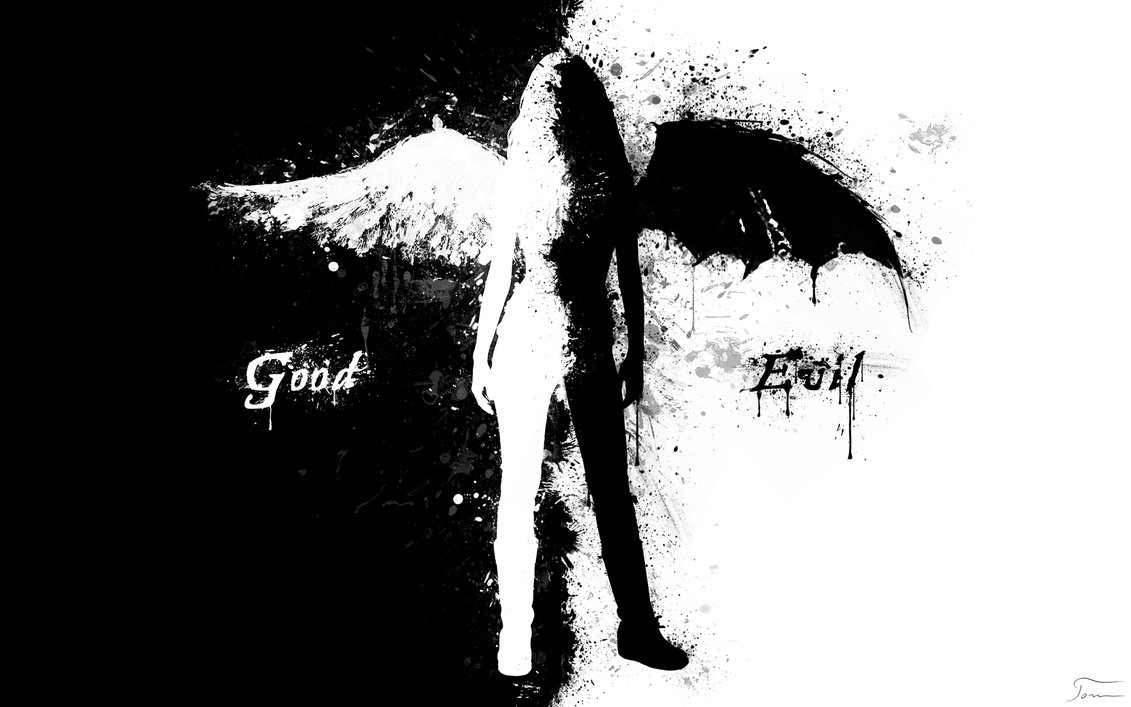
Dehumanization and compassion are black and white.

Humanity is not a privilege. It is our responsibility to be compassionate. Otherwise we are actually less than the other animals. They have no reason and no choice.
 
You cannot have effective communication without agreed upon, firm definitions as a beginning. Otherwise, you end up talking about two different things and there can never be agreement or negotiation, only confused disagreement and escalating anger. Both sides could be right or wrong but there is no way to tell. They're just throwing apples and oranges at each other. They aren't speaking the same language. Language divides as powerfully as it unites.

You aren't considered truly conscious until you define yourself as a self, forming a theory of mind to become a self-aware individual. Only then can you consider others. Language is how we form concepts and express them in life. If mind is a theory, it can be altered by additional concepts. A word can make all the difference. Ideas are harder to defeat than armies because they attack invisibly from within. They can become self-realizing and self-defeating. Defines are the basis of organized thought. Blueprints are definitions. Laws are definitions. Genomes are definitions. It is madness without them.

Colours mark, identify, protect, warn, attract, and confuse. They don't define. White, red, pink, yellow, and black roses are all roses.

That's just my view from the outside edge.

Mistaken Identities: Colour - Kwame Anthony Appiah argues for a world free of racial fixations

In Part 3 of 2016 BBC Reith Lectures, philosopher and cultural theorist Kwame Anthony Appiah argues for a world free of racial fixations.
In Part 3 of 2016 BBC Reith Lectures, philosopher and cultural theorist Kwame Anthony Appiah argues for a world free of racial fixations. (BBC Radio )


In the 2016 BBC Reith Lectures, philosopher and cultural theorist Kwame Anthony Appiah considers Creed, Country, Colour, and Culture. He argues that we over-emphasize scripture in our view of faith; that our concept of nationhood is usually mythical and romantic; that race is 'something we make, not something that makes us"; and that the idea of "Western" civilization is far too limiting. But, he suggests, a broader perspective on all of these offers genuine hope for the world. Recorded in London, Glasgow, Accra in his native Ghana, and New York.

**Please note: This episode is not available to download. Streaming audio is available for listening until February 10, 2017

What makes us who we are?  Is it our religion?  Our nation?  Our race?  Our traditions? None of these things? All of them?

Kwame Anthony Appiah, philosopher, ethicist
(appiah.net/updates)

In the third of his Reith Lectures, philosopher and cultural theorist Kwame Anthony Appiah argues for a world free of racial fixations.

He tells the story of Anton Wilhelm Amo Afer. He was 5-years-old when he was brought from the Gold Coast to Germany in 1707, educated at a royal court and became an eminent philosopher. He argues that this elaborate Enlightenment experiment illuminates a series of mistaken ideas , including that there is a "racial essence" which all members of that race carry. Modern science long ago disproved this, as almost all of the world's genetic variation is found within every so-called racial group.

The lecture is recorded in front of an audience at the British Council in Accra, Ghana. The series is presented and chaired by Sue Lawley.​

Kwame Anthony Appiah grew up in Ghana and in London, the son of a Ghanaian independence leader and an English mother. He's taught at some of the world's top universities, and has written extensively about ethics, honour, and cosmopolitanism.  He's also a novelist, and now teaches philosophy and law at New York University.

Related websites:
​​​​
**The producer of the Reith Lectures for the BBC is Jim Frank.
**The producer of this episode for IDEAS is Dave Redel.


Everything is always in process
Only compassion defeats dehumanization.